
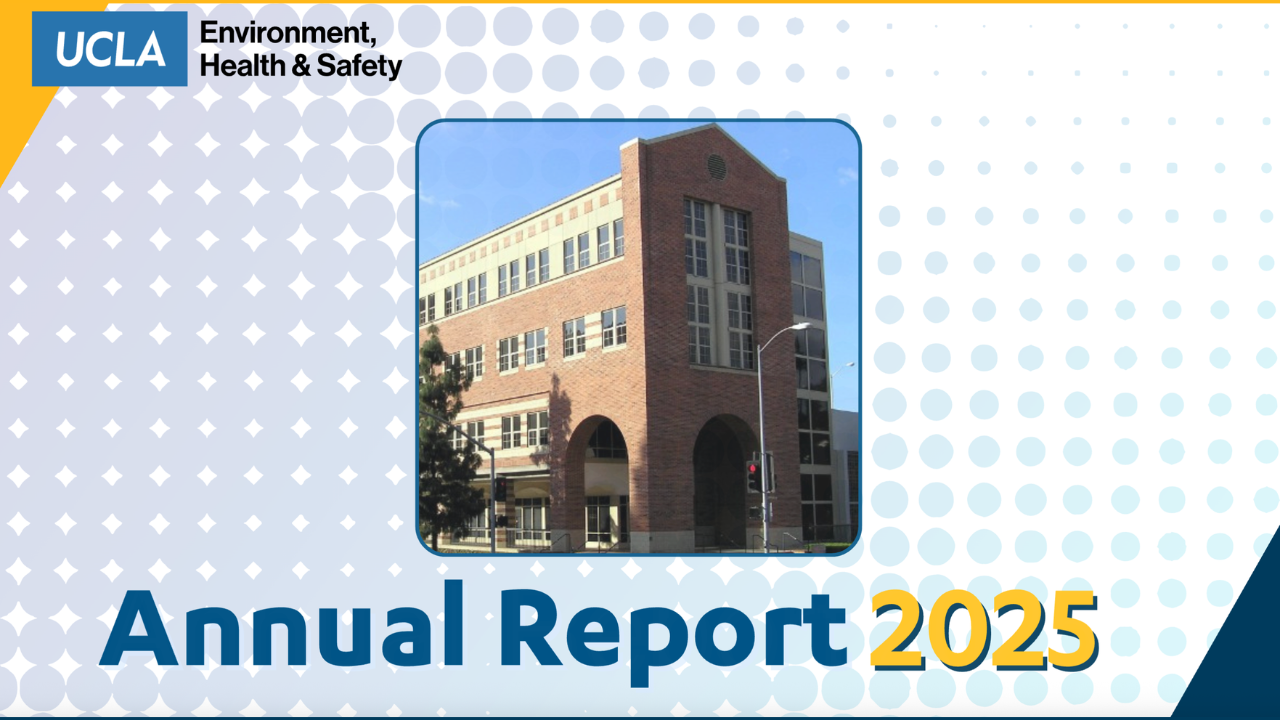
UCLA Environment, Health & Safety has released its 2025 annual report, offering a detailed look at the department’s work and underscoring year‑over‑year progress in building a stronger culture of safety across campus.
“This report is critical in terms of educating our campus community about the role of EH&S, the areas we’re doing well and where we need to focus deeper attention,” said EH&S Quality Assurance Manager Scott Hsieh. “The typical UCLA employee sees us during inspections, but much of our work is out of view.”
While inspections account for roughly one‑third of EH&S activity, the department’s responsibilities extend far beyond that. Staff conduct food safety inspections at campus dining locations – often multiple times per year – respond to odor and mold concerns and perform asbestos surveys before construction or renovation to prevent exposure to hazardous materials.
In 2025, EH&S completed nearly 1,000 workplace inspections, more than 400 industrial hygiene service requests and nearly 400 food safety inspections.
EH&S also triages and responds to smoke alarms, chemical spills and other incidents requiring on‑site investigation. Each response includes a follow‑up review to identify contributing factors and prevent future incidents. The department also manages a wide range of regulatory and administrative functions, including hazardous waste consolidation – which significantly reduces disposal costs – air quality permitting, stormwater compliance, temporary food facility permits and construction plan checks.
The report highlights several major accomplishments from 2025. Among them is the launch of the Environment, Health & Safety Assistant, a web‑based system that gives researchers direct access to their safety information, including inspection results and safety climate survey data. The department also introduced ChemTag, a program that streamlines chemical inventory management and improves accuracy, and completed its first campus safety climate survey.
Hsieh said UCLA has seen a steady shift toward a more proactive safety environment. “There's been a lot of restructuring, planning and emphasis on safety culture over compliance culture; that's been a consistent factor over time,” he said. “I think the emphasis on being visible – trying to get out there, talking to people – has really helped contribute to this.”
UCLA’s annual Campus Safety Week reinforces that effort, bringing together students and employees for resources, demonstrations and training. This year’s event, held May 4–8, drew participation from departments across campus, including Housing & Hospitality and Facilities Management.
The 2025 report identifies slips, falls and ergonomic injuries as leading contributors to workplace incidents. Hsieh encourages employees to address everyday hazards – such as spills, cluttered walkways and workstation setup – and reminds the campus community that the UCLA Evaluations and Ergonomics Lab is available for workstation assessments and ergonomic support.
The full annual report provides additional data, trends and resources for the campus community.