
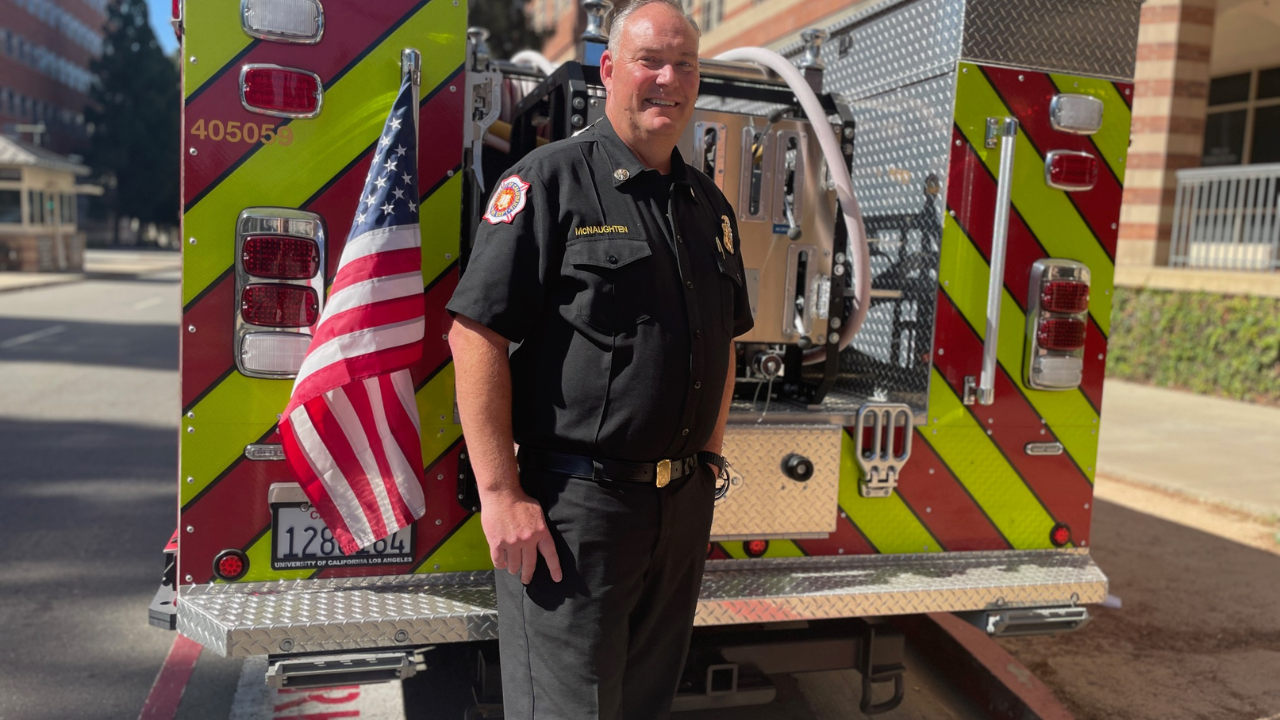
Few professions deliver emotional highs and lows as intensely as the fire service. Over his 30-plus-year career, Steve McNaughten, UCLA’s new lead campus fire marshal, has protected landmarks such as the Getty Museum and the Ronald Reagan Presidential Library, helped save lives on land and water, delivered six babies and comforted families in moments of devastating loss.
“I’ve seen the best, and I’ve seen the worst,” said McNaughten, who spent years as a firefighter with the city of Oxnard before rising through the ranks to become battalion chief and fire marshal. Most recently, he served at UC San Francisco as a designated campus fire marshal. “University campuses can have some interesting challenges when it comes to fire prevention, but overall, they are special places to serve, and I’m proud to be here.”
At UCLA, McNaughten leads a team of fire safety professionals primarily responsible for fire prevention and related life safety efforts for the campus. He taught fire technology at Oxnard College and EMT courses at Ventura Community College for more than a decade and has led classes for the American Red Cross and the Office of the State Fire Marshal. As the senior authority for fire and life safety across all UCLA‑owned or managed campus properties, McNaughten oversees institution-wide fire protocols, emergency response, construction plan reviews, fire code enforcement, prevention initiatives and investigative operations. His counterpart in UCLA Health is Ricardo “Rico” Barboza.
Housed within UCLA Environment, Health & Safety, UCLA Fire operates differently from a traditional municipal fire department, he says. While city departments provide 24-hour service and have a large focus on frontline emergency response, UCLA Fire functions as a California state fire authority on all aspects of fire safety. Its mission is to identify hazards and mitigate risks before emergencies occur. Emergencies reported between 6 a.m. and midnight are handled by UCLA Fire’s initial response unit. Fires beyond the incipient phase — the earliest stage, when flames are small and smoldering — or incidents occurring after hours are managed by the Los Angeles Fire Department.
Education and readiness are other core components of UCLA Fire’s work. The department provides prevention and safety training and injury prevention modules tailored to laboratory personnel, welders and other specific hazards at UCLA. In addition to fire safety, hotwork training and permit training through WorkSafe, it also offers courses on residential safety and fire extinguisher classes for work and home.
“It’s important that people know how to prevent fire and what to do in the event of a fire or other emergency,” McNaughten said. “Things are going to happen — it’s inevitable — so it’s important to know how to minimize impact.”