
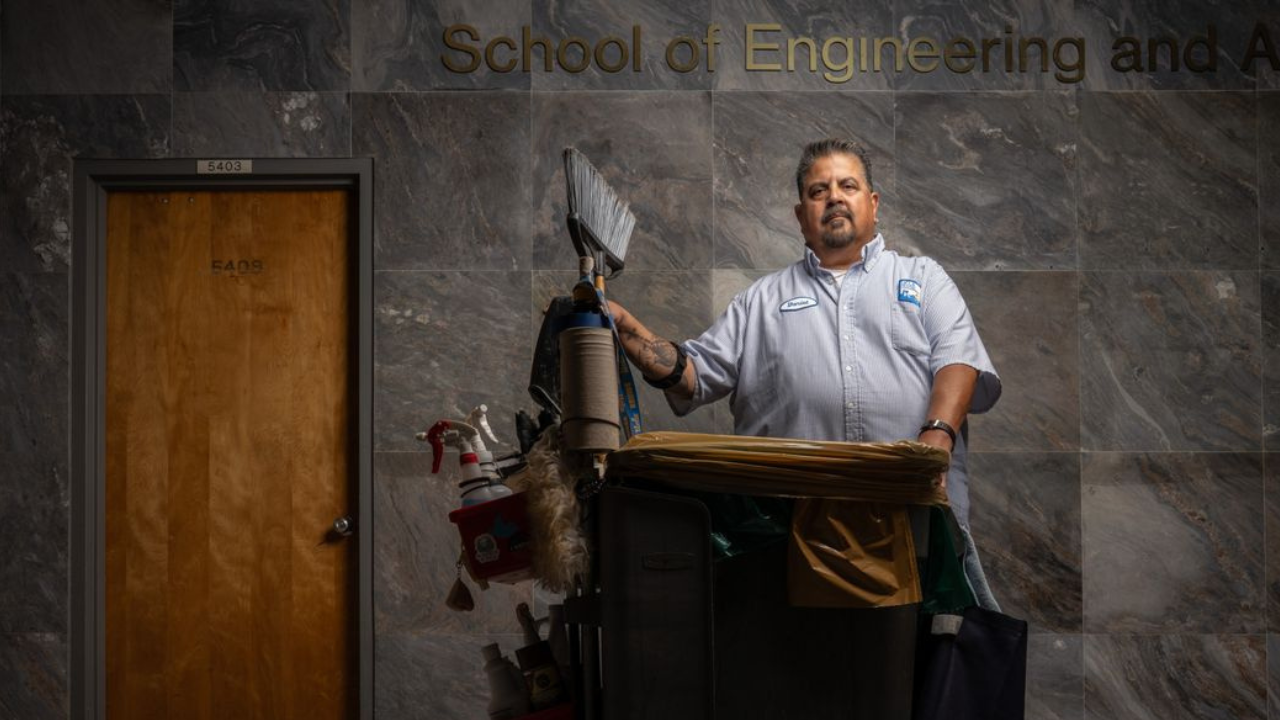
For 15 years, Daniel Estrada has spent his nights moving quietly through UCLA’s hallways and classrooms, cleaning up after a whole generation of students long after most of campus has gone home, gleaning knowledge along the way.
The senior custodian recently stepped into the spotlight as one of 10 speakers at TEDxUCLA on May 26, offering a perspective shaped not by lecture halls or laboratories but by years spent observing university life behind the scenes.
Over thousands of late-night shifts, Estrada has developed a candid philosophy about responsibility, shaped as much by abandoned e-scooters in elevators and clogged toilets as by the students he has quietly watched grow up on campus.
His critique comes with real affection for the students he encounters, including those he has seen studying into the early morning hours or those who reach out after graduation to thank him for the conversations they shared during late-night shifts.
Still, years spent cleaning up the consequences of small acts of carelessness and disregard for simple building rules eventually helped shape the blunt musing that anchored parts of his TEDx talk:
“How are you going to change the world if you can’t even flush the toilets?” Estrada said with a laugh during a recent interview, recalling some of the stranger moments of campus custodial life.
Estrada’s custodial duties cover portions of Boelter Hall and the Mathematical Sciences Building.
Estrada’s question captures the spirit of the talk he has been developing with TEDxUCLA organizers and coaches in recent months. The presentation, which Estrada wrote with help from the UCLA Writing Programs, reflected on personal responsibility, work ethic and the importance of taking ownership of even the smallest tasks.
TEDxUCLA lead student organizer, Cylin Wang, first met Estrada unexpectedly while wandering through the upper floors of the Mathematical Sciences Building with several other students. Estrada offered to show the group the rarely accessed 10th-floor view.
Afterward, the conversation continued.
“She was like, ‘After talking to you, it really changed my point of view and my thought process,’” Estrada recalled. “And I’m like, me?”
At the time, Wang had not yet begun reviving TEDxUCLA for the campus community. But when she later began organizing the event, Estrada was one of the first people she knew she wanted on stage.
Part of what struck Wang was Estrada’s ability to articulate the invisible labor that keeps a university functioning – from custodians to groundskeepers, from plumbers and painters to food service workers – along with the candid view it offers of student behavior.
“I was like, ‘Danny has to speak,’” Wang said. “He’s a custodian who’s been here for 15 years, and one conversation with him in the hallways just opened my world so much.”
Read the full story via the UCLA Newsroom.